


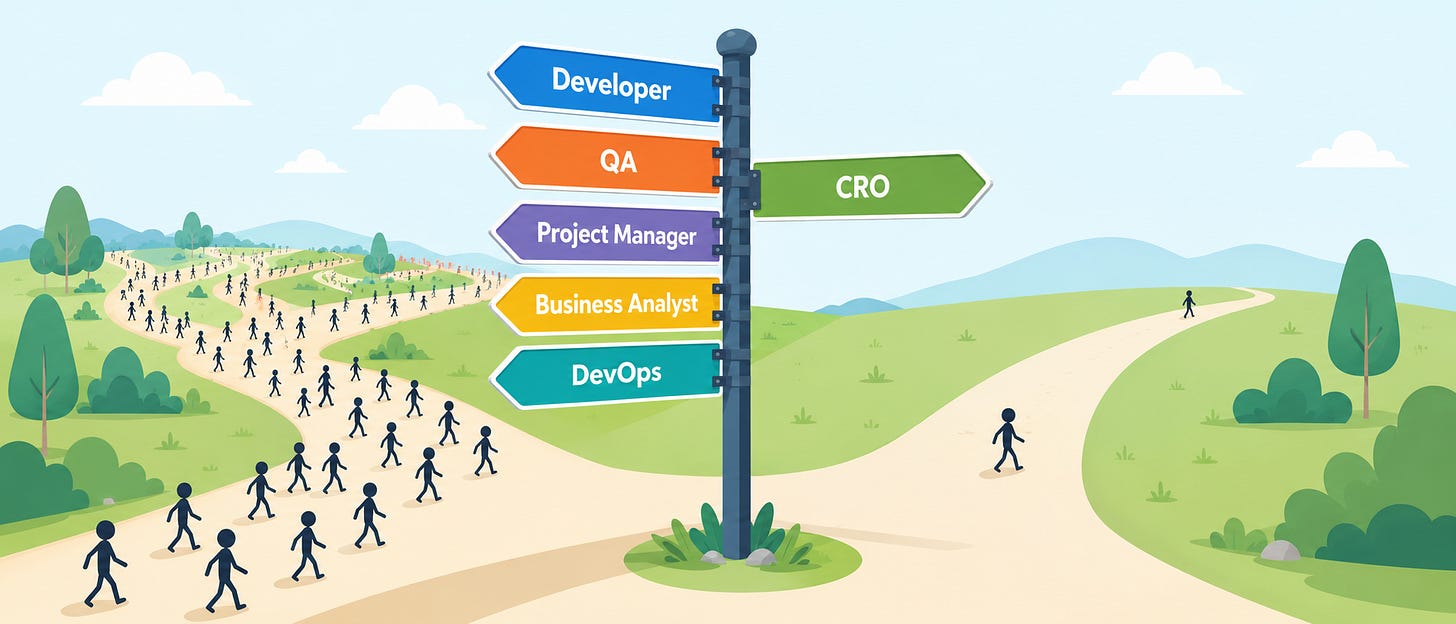
When I ask any of my student what they want to be? I mostly get one of the five answers: Developer, QA, Project Manager, Business Analyst, and now DevOps too.
Nobody says “CRO”, because nobody knows it exists. A few years ago, this was the state with DevOps too :)
What Is CRO?
Conversion Rate Optimization. The job to figure out why people visit a website and leave without buying, signing up, or clicking the button, and then fixing it. Not by guessing but by testing, perhaps even by some coding.
Here’s what you already know.
Dev builds the product.
QA makes sure it doesn’t break.
BA figures out what the business needs.
CRO figures out why real humans aren’t doing what the business hoped, and runs experiments to fix it. With lots of tools again.
Tech, psychology, and data, all in one job.
Classic one: “But I’m Not Great at Coding”
If you don’t want to code at all. Stop reading here. Some coding will always be needed in all tech. But Relax! You don’t need DSA or LeetCode for this. What actually helps here is:
Basic HTML/CSS, enough to know what “move the button above the fold” means. You learn this mostly in the initial classes, of course I am making some assumptions here.
A little JavaScript, enough to talk to developers and state some requirement. Better if you could do it yourself.
Comfort with numbers, enough to know 40% improvement means nothing if only 20 people saw it. Some exposure to good tools like Google Analytics.
That’s it. CRO rewards curiosity about human behaviour, not coding depth.
A Day in CRO
Look at heatmaps. Watch session recordings of real users struggling. Check analytics reports. Understand human behavior. Form a hypothesis. Run an A/B test. Wait patiently (no declaring winners on Day 2). Read the results honestly. Tell a non-technical team what it all means.
Partly a detective work, partly experiment design and most part is communication.
Why Should you do This
All freshers applying for a dev role are competing with a thousand others who did the same DSA course and built the same to-do app. CRO is comparatively empty. Businesses don’t jsut need hi-tech people, they also need a mix of both who get the tech and the human side of a website, and almost nobody of your age is positioning for it yet.
Bonus: skills from Dev, QA, BA, and DevOps all transfer. So, you are not just starting from zero. You are switching lanes.
CRO in India, Right Now
The most exciting part for Indian students is here. India is now the world’s second-largest home for A/B testing software companies, behind only the US, according to Tracxn data. Some of the well-known tools in this space are all built by Indian founders. This isn’t a niche American thing you’re late to. It’s actively being built here, right now, with real jobs behind it.
And it’s moving past “just buy a tool” into “build a culture around it,” with practitioner meetups and roundtables popping up in Indian cities. Translation: the ecosystem is young enough that showing up early actually means something. Some fo the recent events around it is something I keep posting about and you will hear more about it from me.
Reference: Best A/B Testing Tools in India
Start This Week
Install Microsoft Clarity (free) on any personal project and just watch how people use it
Try Convert.com’s 15-day free trial to see what an actual A/B testing tool looks like from the inside
Learn the four experiment types: A/A, A/B, split URL, multivariate. At least start with the easiest ones i.e. A/A and A/B.
Write one hypothesis: “If I change X, then Y will happen, because Z”. This is important. If you master this, you know how the product and its users/buyers interact.
That’s pretty much it. (Of course more but I don’t want to scare you :) )
I teach DevOps and cloud subjects to students, and work at Convert.com. Curious about CRO? Drop a comment.


 Posts
Posts


0 comments:
Post a Comment