Last week I went toMeasureCamp Delhi 2026. This was their 200th event and indeed a special one. Before going, I had a simple picture in my head. Rows of chairs. A stage. Some speakers talking. Us nodding along. Chai/Coffee in between. Maybe a goodie bag at the end. People looking to sell their product every now and then. Group of students clicking selfies all over. The standard conference deal we have all attended at least fifty times in our careers.
I was wrong indeed.
MeasureCamp is something called an "unconference." When I heard the word for the first time, I thought maybe they forgot to plan the conference part. It was on purpose though. There is no fixed agenda. The event starts with a short intro, sponsors get their thank you, and then they show you a big blank board with time slots and room numbers. That board is the real hero of the day. Here is a picture:
Speaker/Event Session Board
I remember pre-covid days, I did something similar. As a meetup organizer at DevOps Pune and after getting some inspiration Seattle meetup groups, I started working onLeancoffeeformat of meetups since we were getting lot of marketing pitches back then. Here is what Leancoffee is. Definition copies as it is from their site.
Lean Coffee is a structured, but agenda-less meeting. Participants gather, build an agenda, and begin talking. Conversations are directed and productive because the agenda for the meeting was democratically generated.
So I now assumed this Unconference was probably the same, with a new name. But again, I was wrong.
Here is what happens. If you want to speak on something, you write it on a small card, stick it on the board, and boom, you are now a speaker. No approval committee. No forms. No "we will get back to you." If people like your topic, they walk in. If they don't, you get a very empty room and a good lesson in humility.
Only one rule was strict. No pitching your company. Sponsors already pay for that privilege, so the rest of us just talk shop, not sales. Once that rule was set, every conversation in the building felt honest. Nobody was secretly selling you a subscription while pretending to chat.
Wow! It sounded good and scary at the same time. Good, because
This was different. A different learning experience is always good.
No marketing pitches. As an organizer, I know how bad this can get.
I could choose who and what I want to listen to.
So many good topics being displayed and so much to learn.
Scary because:
Embarrassment of not having any audience if you end up becoming a speaker.
Fear of missing out on good speakers if multiple good events go in parallel.
My colleagueRohan Deshpandeand I went there just to attend, representingConvert.com, nothing more. No plan to speak, no slides, nothing prepared. But after the opening session, we looked at the board, looked at each other, and thought, why not? We put up a session on how AI has been sneaking into troubleshooting and internal workflows at CRO and A/B testing companies. Basically the stuff we have been quietly doing for months.
We kept it in a very informal discussion format. In fact, I sat down with the attendees just facing them. More like a group chat than a lecture. About 15 to 20 people joined. And the questions came fast. Do you actually trust AI's calls or are you just being brave? Where is this going for testing platforms? Personalization, traffic tracking, integrations with tools people already use daily. People were genuinely curious, not just polite.
Best part of the whole day, honestly. We did not plan to speak, did not prepare a single slide, and still walked away with speaker mementos. Somehow that felt more earned than if we had rehearsed it for a week.
This time the turnout was around 120 plus people. I think they expected more, but Delhi was also hosting the BRICS summit that same day, so a lot of people probably got stuck in traffic or security barricades instead of analytics discussions. Still, seven breakout rooms ran side by side the whole day, and people moved between rooms freely, following their curiosity, not any fixed schedule.
I also sat in on a few sessions myself. One on attribution problems in ads and CRO. One on moving from GA4 to Amplitude. One on data governance and AI. And one with a title that stuck with me, "How Data Lie." Every session was run by someone actually doing the work, not someone presenting a fancy case study made for likes.
But if I am honest, no single session was the best part. The people were. I met folks from Amplitude, founders running their own analytics platforms, and CRO experts who have worked with some really big consumer brands. Normally this kind of networking takes weeks of cold emails and LinkedIn requests that nobody replies to. Here it happened in five minutes near the coffee counter.
This was also the 200th MeasureCamp Delhi event, which is no small number. A big thank you to the organizers and volunteers who pulled this off. Running an unconference sounds easy on paper, "just let people talk," but making that chaos actually work smoothly takes real effort. They did a solid job. Thank you so much for all the work.Tanmay GargPriya DhimanAnuj B.Abhishek DeswalSorry if I missed anyone here.
If you work anywhere near analytics, data, or experimentation, and you have never been to a MeasureCamp, go once. Go with zero expectations. That is honestly the whole point.
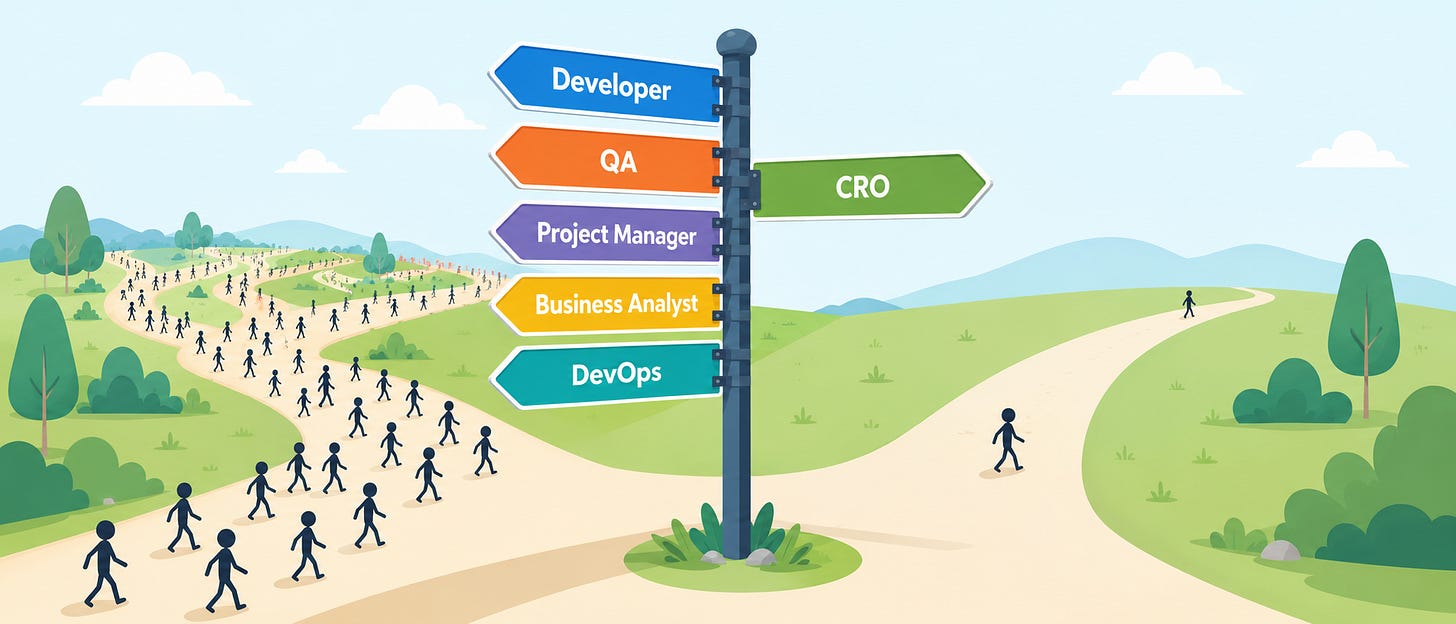
When I ask any of my student what they want to be? I mostly get one of the five answers: Developer, QA, Project Manager, Business Analyst, and now DevOps too.
Nobody says “CRO”, because nobody knows it exists. A few years ago, this was the state with DevOps too :)
What Is CRO?
Conversion Rate Optimization. The job to figure out why people visit a website and leave without buying, signing up, or clicking the button, and then fixing it. Not by guessing but by testing, perhaps even by some coding.
Here’s what you already know.
Dev builds the product.
QA makes sure it doesn’t break.
BA figures out what the business needs.
CRO figures out why real humans aren’t doing what the business hoped, and runs experiments to fix it. With lots of tools again.
Tech, psychology, and data, all in one job.
Classic one: “But I’m Not Great at Coding”
If you don’t want to code at all. Stop reading here. Some coding will always be needed in all tech. But Relax! You don’t need DSA or LeetCode for this. What actually helps here is:
Basic HTML/CSS, enough to know what “move the button above the fold” means. You learn this mostly in the initial classes, of course I am making some assumptions here.
A little JavaScript, enough to talk to developers and state some requirement. Better if you could do it yourself.
Comfort with numbers, enough to know 40% improvement means nothing if only 20 people saw it. Some exposure to good tools like Google Analytics.
That’s it. CRO rewards curiosity about human behaviour, not coding depth.
A Day in CRO
Look at heatmaps. Watch session recordings of real users struggling. Check analytics reports. Understand human behavior. Form a hypothesis. Run an A/B test. Wait patiently (no declaring winners on Day 2). Read the results honestly. Tell a non-technical team what it all means.
Partly a detective work, partly experiment design and most part is communication.
Why Should you do This
All freshers applying for a dev role are competing with a thousand others who did the same DSA course and built the same to-do app. CRO is comparatively empty. Businesses don’t jsut need hi-tech people, they also need a mix of both who get the tech and the human side of a website, and almost nobody of your age is positioning for it yet.
Bonus: skills from Dev, QA, BA, and DevOps all transfer. So, you are not just starting from zero. You are switching lanes.
CRO in India, Right Now
The most exciting part for Indian students is here. India is now the world’s second-largest home for A/B testing software companies, behind only the US, according to Tracxn data. Some of the well-known tools in this space are all built by Indian founders. This isn’t a niche American thing you’re late to. It’s actively being built here, right now, with real jobs behind it.
And it’s moving past “just buy a tool” into “build a culture around it,” with practitioner meetups and roundtables popping up in Indian cities. Translation: the ecosystem is young enough that showing up early actually means something. Some fo the recent events around it is something I keep posting about and you will hear more about it from me.
Install Microsoft Clarity (free) on any personal project and just watch how people use it
Try Convert.com’s 15-day free trial to see what an actual A/B testing tool looks like from the inside
Learn the four experiment types: A/A, A/B, split URL, multivariate. At least start with the easiest ones i.e. A/A and A/B.
Write one hypothesis: “If I change X, then Y will happen, because Z”. This is important. If you master this, you know how the product and its users/buyers interact.
That’s pretty much it. (Of course more but I don’t want to scare you :) )
I teach DevOps and cloud subjects to students, and work at Convert.com. Curious about CRO? Drop a comment.
Because the loudest idea in the room is not always the best experiment.
In the last post, I wrote about the main experiment types: A/A, A/B, Split URL, and multivariate testing. I also introduced the formula that quietly changed how I think about experimentation:
Success = Chance × Frequency
Once that clicked, I assumed the next step would be simple.
Pick an idea > Run a test > Measure it > Repeat.
Then I actually tried to do it. Because once people around you start thinking in CRO terms, ideas come from everywhere.
The designer wants to test the hero image. The founder wants to rewrite the pricing page because “it does not feel premium enough.” Someone from sales heard that a competitor changed their CTA and now wants to copy it immediately. Someone read a blog at midnight and suddenly wants to add a chatbot, a quiz, a floating banner, and possibly a dancing mascot.
Before you know it, your experiment backlog looks like a Jira board after a chaotic sprint planning session.
Lots of tickets.
Very little structure.
Everyone convinced their idea is the one that will change the company’s destiny.
This is where prioritization comes in. Not because prioritization makes you smarter, but because it protects the experimentation program from becoming purely opinion-driven. And in CRO, opinions can multiply faster than credit card debts.
The Hidden Cost of Running the Wrong Test
At first, “let’s just test this” sounds harmless. CRO is about experimentation, right? Just run everything. But every test has a cost.
Even when the testing tool makes setup easy, a test still consumes traffic, time, design effort, analysis attention, and usually a couple of weeks of your roadmap. If your site has enough traffic to run two meaningful tests this month, and your backlog has twenty ideas, running the wrong two means you delayed the better ones. That is not a small cost.
This felt immediately familiar from Devops work. You do not deploy every feature request just because someone suggested it in a meeting with confidence and a nice slide deck. You triage. You look at impact, risk, effort, dependencies, and what the system is actually telling you before you start making changes.
CRO needs the same discipline. An idea is not valuable because it sounds smart in a meeting. It becomes valuable when it is connected to evidence and scored against other ideas in the backlog.
The HiPPO Problem
Before getting into frameworks, there is a force you need to understand. It quietly kills many CRO programs. It is called the HiPPO: the Highest Paid Person’s Opinion. Every team has one. In fact there is a rude saying about opinions. “Opinions are like…” (well… Google it)
The senior leader who says, “I think the button should be green,” and suddenly the next sprint is about button colors. The founder who saw a competitor’s landing page and wants to rebuild yours to match it by Thursday. The VP who has “a feeling” about the checkout flow. The stakeholder who says, “Can we just test it?” in the same tone people use before creating six months of technical debt.
To be fair, these inputs are not useless. People close to the business often have genuine intuition worth exploring. Sales teams hear objections. Support teams hear confusion. Founders understand positioning. Product teams know what users struggle with. The problem is not the idea. The problem is when the idea skips the queue without being scored.
In DevOps, we do not prioritize incident response based on who is shouting loudest in Slack. At least, we should not. We prioritize based on system impact and what the metrics are actually saying.
CRO needs the same structure. A prioritization framework is your polite defense against the HiPPO.
You are not saying: “No, your idea is bad.”
You are saying: “Great, let’s score it the same way we score everything else. If it ranks high, it goes first.”
That small shift changes the conversation. The framework depersonalizes the argument. The number does the heavy lifting. Very convenient, because numbers do not get awkward in meetings.
Start With the Funnel, Not the Idea
Before scoring individual test ideas, figure out where to look first. Not every page deserves equal attention. A page with very little traffic will take forever to produce statistically meaningful results. A page with high traffic but no meaningful business impact may still not be worth optimizing ahead of a page that sits directly in the conversion path.
Press enter or click to view image in full size
So before asking: “What should we change?” ask, “Where are we losing people?”, and then. Map your funnel.
Landing page > Form view > Form start > Form submit > Qualified lead
Then look at where the biggest drops are happening. If 70% of users are abandoning at checkout, testing a homepage headline is probably not the first move.
It might be interesting.
It might even win.
But it is probably not where the biggest leak is.
Analogy in DevOps: If the database is causing 90% of your latency, shaving 20ms off a frontend asset is not the priority. Sure, the frontend improvement may look nice in a performance report. But the database is still sitting there like an overloaded elephant in the server room.
Find the bottleneck first. Then fix it. In CRO, high-traffic pages close to revenue, signup, checkout, or lead generation are your hot paths. Start there.
Small disclaimer:Read at your own risk. This may make you hungry
The Two Frameworks: ICE and PIE
Once you know which pages to focus on, you need a way to score the ideas sitting in your backlog. Two common prioritization frameworks in CRO are ICE and PIE. Both are simple, both use overlapping dimensions and both are easier to remember if you stop thinking about frameworks and start thinking about food. Which, honestly, improves most business concepts. ;)
ICE: Ordering Food at Midnight
ICE stands for:
Impact
Confidence
Ease
Think of ICE as ordering food on delivery app at 11 pm. You are hungry. You are tired. You are already in bed. This is not the time for adventure. You are not trying to discover a hidden culinary gem. You are trying to avoid sleeping angry. You see a biryani place.
Before you tap “Order,” three thoughts happen automatically.
First:
“How good is this actually going to be?”
If it is bad biryani, why bother?
That is Impact.
Second:
“Can I trust this place right now?”
Will it arrive hot, on time, and with raita? Or will it arrive cold, late, and missing the one thing that emotionally holds the whole meal together? You check the rating, reviews, delivery time, and whether someone recently complained that they received only rice and sadness.
That is Confidence.
Third:
“How easy is this?”
Is the restaurant open? Is delivery available? Will it reach in 25 minutes, or will the app say “arriving soon” until you lose hope? Will it ask you to verify your phone number again even though it has known you for five years?
That is Ease.
ICE is practical and slightly paranoid. It wants evidence before committing.
In CRO terms:
Impact asks: If this test wins, how much could it move the business? Confidence asks: How sure are we that this is a real problem worth testing? Ease asks: How difficult will this be to build, QA, launch, and analyze?
Score each dimension from 1 to 5. Then average the three. The highest-scoring ideas usually go first. ICE works especially well when you already have research data: heatmaps, recordings, analytics, surveys, support tickets, or past experiment learnings. Low confidence should lower the score, no matter how exciting the idea sounds.
Because “I saw this on a competitor site” is not research. It is browsing with ambition.
PIE: Choosing What to Order When You Have Options
PIE stands for:
Potential
Importance
Ease
Now stay in the same food delivery app. You are still hungry. It is still 11 pm. You still should have eaten earlier like a responsible adult, but here we are. This time, you are not evaluating one biryani place. You are deciding what category of food deserves your attention first.
Biryani? Pizza? Rolls? South Indian? Chinese? That one “healthy bowl” option you add to cart and then remove after seeing the price? PIE helps you decide where the biggest opportunity is.
First:
“How good could this get?”
Could this be the kind of meal that fixes your mood, your evening, and possibly your belief in humanity?
That is Potential.
Second:
“How important is this meal?”
Is this a casual snack, or have you skipped dinner and now your stomach is sending production-level alerts?
That is Importance.
Third:
“How easy is it to get?”
Is it nearby and deliverable in 25 minutes, or is the restaurant far away, closing soon, and likely to cancel after making you wait?
That is Ease.
PIE is more optimistic than ICE.
ICE asks, “Can I trust this specific choice?”
PIE asks, “Where is the biggest opportunity?”
In CRO terms:
Potential asks: How much improvement could this page or funnel step realistically have? Importance asks: How valuable is this page or funnel step to the business? Ease asks: How simple or difficult is the test to implement?
PIE is useful when you are comparing broader areas of opportunity.
For example, if you are deciding whether to focus on the homepage, pricing page, checkout, signup form, or onboarding flow, PIE can help you decide where the biggest opportunity may be.
So, in food delivery terms:
ICE helps you decide whether to trust one restaurant. PIE helps you decide which food category is worth exploring first.
ICE vs PIE: The One-Line Difference
Press enter or click to view image in full size
Here is the easiest way I remember them:
ICE helps you decide whether to trust one restaurant. PIE helps you decide which food category is worth exploring first.
ICE is about confidence. Can I trust this specific option to deliver? PIE is about opportunity. Which area has the biggest upside if I focus there? Same food app. Different thinking.
With ICE, you are asking: “Should I order from this biryani place?” With PIE, you are asking: “Should I even be looking at biryani first, or is pizza, rolls, South Indian, or Chinese the better opportunity tonight?”
Both end with Ease, because nobody wants unnecessary complications at 11 pm. Especially not when they are hungry and the app is already saying, “Restaurant is closing soon,” like it is adding pressure to your life.
Which Framework Should You Use?
Use ICE when your team already has research data and wants to prioritize based on evidence. ICE is useful when you are evaluating a specific hypothesis. For example:
“Should we move the CTA above the fold on the pricing page?”
You already have heatmap data. You know users are not scrolling far enough. You want to know whether this specific idea deserves to be tested next. That is ICE.
Use PIE when you are earlier in the process and still deciding where the biggest opportunity is.
For example:
“Should we focus on the homepage, pricing page, checkout flow, signup form, or onboarding?”
That is PIE.
At Convert.com, the Compass feature includes both PIE and ICE inside the hypothesis builder. When you create a new hypothesis, you can choose a framework, score each dimension on a scale of 1 to 5, and use that score to sort your backlog.
That helps because the score becomes visible to everyone. It is much harder to push your pet idea to the top when the number is sitting right there on the screen, judging you quietly. A visible score is like the delivery rating on a food app. You can still order from the suspicious restaurant. But now everyone can see that it has 2.3 stars and seven reviews mentioning “never again.”
Turn Ideas Into Hypotheses Before You Score Them
Press enter or click to view image in full size
One thing both frameworks require is that your ideas are written properly before scoring.
“Change the button color” is not a hypothesis.
“Move the CTA above the fold” is not a hypothesis.
“Make the page look more premium” is definitely not a hypothesis.
That is a mood.
A proper hypothesis looks like this:
If I change X, then Y will happen, because Z.
The “because” is the most important part. Without it, you are not testing an assumption. You are just making a change and hoping the graph goes up, which is basically the CRO version of deploying to production and whispering, “Please work.”
Or, to stay with the food delivery analogy, it is like ordering from a restaurant with no ratings because the photo looked nice. Could it be amazing? Maybe. Could it be regret in a plastic container? Also maybe.
For example:
If we move the main CTA above the fold on the pricing page, more visitors will start the demo request flow, because heatmaps show most users are not scrolling far enough to see the current CTA.
Now you have something worth scoring.
You know:
The page
The change
The expected outcome
The evidence behind it
Even if the test loses, you learn something specific. A backlog full of vague ideas becomes a dumping ground. A backlog full of hypotheses becomes a learning system.
Or in food terms:
“Order something nice” is not useful.
“Order from a highly rated nearby restaurant because delivery time is low and reviews mention fresh food” is much better.
Specificity saves you from bad decisions. And occasionally, bad paneer.
The One Thing ICE and PIE Get Wrong
ICE and PIE are useful, but they share a blind spot. They often treat every idea as if it exists in a vacuum. But it does not.
Every idea exists inside the history of your previous tests. If you have run five tests on your pricing page and four of them lost, your confidence score for the next pricing-page idea should reflect that history. Something on that page may be resisting your assumptions.
Maybe the traffic quality is different from what you expected.
Maybe the real problem is upstream in the funnel.
Maybe people already understand the pricing page, and the actual friction is in signup.
Maybe your pricing page is innocent and has been framed by bad hypotheses.
The same applies to food delivery. If you have ordered from the same restaurant four times and three times they forgot the raita, you should not treat the fifth order like a fresh mystery.
You have history. Use it. Past experiment results should feed into how you score new ideas. They should not sit inside a spreadsheet named something like: final_results_v3_really_final_updated_NEW.xlsx
This is why documentation matters as much as the framework itself.
After every experiment, write down:
The hypothesis
The result
The confidence level
The primary metric
The key learning
What it suggests about the next test
Even a losing test is useful if it tells you where not to look. Without this history, your backlog resets to zero every quarter. With it, your scoring gets more accurate over time because you are building a picture of what your specific audience actually responds to. A CRO backlog without documentation is like a food app that forgets every bad order you ever had. You keep making the same mistake. And somehow, the raita is still missing.
What to Do When Everything Scores the Same
Sometimes three ideas all score 4.2 and suddenly you are back in the same argument. This is normal. Frameworks help, but they do not eliminate judgment. A few tiebreakers can help. Pick the page with the most traffic. More visitors usually means faster results and less time waiting for statistical significance.
In food delivery terms, this is like choosing the restaurant with enough recent orders and reviews. If only two people have ordered from it since 2021, the rating may not tell you much.
Pick the test that is fastest to build. A high-scoring idea that takes three weeks of development work may be worth doing after a slightly lower-scoring idea you can ship in a day. Remember the frequency side of the success formula.
This is the difference between ordering something that arrives in 25 minutes and choosing a dish that says “preparation time: 95 minutes.”
Technically, it may be great. Emotionally, you may not survive. Pick the test that teaches you the most regardless of outcome. Learning value is underrated. A test that answers a fundamental question about your audience is worth more than a test that optimizes something already working reasonably well.
In other words, do not only ask:
“What might win?”
Also ask:
“What will we learn even if this loses?”
That question saves a lot of time. And occasionally, a lot of ego.
Define Success Before You Launch, Not After
One mistake that shows up in beginner backlogs is choosing the primary metric after the test has already started. That is dangerous. If you look at enough metrics, something will always appear to have improved.
Clicks went up.
Scroll depth changed.
Form starts increased.
Time on page looked different.
Someone in Nebraska spent 14 minutes reading the footer.
But what was the experiment actually supposed to improve? Every test needs a primary metric before launch.
Demo requests.
Purchases.
Trial signups.
Form completions.
Revenue per visitor.
Pick one. Commit to it. Let that metric make the call. This is like deciding what “good food” means before ordering. Are you optimizing for taste? Delivery speed? Price? Portion size? Not waking up with regret? If you decide after the food arrives, you can justify anything.
“The biryani was cold, but the container was sturdy.”
That is not success. That is coping. You can still watch secondary metrics for learning, but the decision should rest on the primary one. And alongside your primary metric, define your guardrail metrics. These are the things you are not directly trying to improve, but cannot afford to break. For example:
If you are optimizing demo signups, lead quality should not drop.
If you are optimizing checkout completion, average order value should not fall.
If you are optimizing form completion, spam submissions should not explode.
If you are optimizing clicks, downstream conversions should not suffer.
This is the CRO version of SLOs. You define what success looks like and what failure looks like before you are emotionally invested in the outcome. A test that increases clicks while damaging qualified leads is not a win. It is noise wearing a party hat.
Or in food delivery terms: A restaurant that delivers in 12 minutes but sends the wrong order did not “win on speed.” It failed dinner.
A Practical First Backlog
If you are starting from zero, here is the workflow I would follow.
Map your funnel and identify the biggest drop-off point.
Use heatmaps, session recordings, analytics, surveys, and any sales or support feedback you can access.
Write down every test idea without judging too early.
Convert each idea into a proper hypothesis using the “If X, then Y, because Z” format.
Score each one using ICE or PIE.
Pick one high-scoring, reasonable-effort test.
Define the primary metric and guardrail metrics before launch.
Run the test.
Document the result and the learning.
Then re-score the backlog based on what you now know.
That last step is what most teams skip. And it is what separates a backlog that compounds from one that stagnates. A CRO backlog should not be a parking lot where ideas go to quietly disappear. It should be more like a living system.
Or, to stay on brand, a well-maintained CI/CD pipeline for learning. Every test should make the next decision smarter. Just like every food order teaches you something.
Restaurant is reliable.
Delivery is slow on weekends.
The “extra spicy” option is not a personality test you need to pass.
Never trust a place where every menu item has the same stock photo.
Learning compounds when you write it down.
The Real Takeaway
Prioritization is not about finding the cleverest idea. It is not about the biggest redesign. It is not about the most senior opinion in the room. It is about running the tests that have the best combination of meaningful impact, strong evidence, reasonable effort, and clear learning potential. Done consistently, this turns CRO from a collection of random experiments into a learning system. You find the biggest leaks, collect evidence, write hypotheses, score ideas, run the most valuable tests first, document what happened and then repeat.
The DevOps parallel is hard to miss. Good infrastructure teams do not just ship more changes. They improve how they decide what to change, how they measure it, and how they learn from it.
Good CRO teams do exactly the same thing. And the food delivery parallel is also hard to miss. The goal is not to order everything on the menu. The goal is to make better choices each time, based on what you know, what matters, what is realistic, and what you learned last time.
That is prioritization.
In the next post, I want to go deeper into reading results without fooling yourself: statistical significance, confirmation bias, and why the most dangerous moment in CRO is when a test is almost winning.
I work with Convert.com and write about the intersection of DevOps and experimentation. If you are building your first CRO backlog or trying to move your team away from opinion-driven testing, drop a comment or reach out. Happy to compare notes.
When my manager first mentioned A/B testing, I nodded confidently. I knew exactly what it was.
Except I didn’t.
In my head, “A/B testing” meant Apache Benchmark, the ab command-line tool DevOps engineers use to hammer HTTP servers and measure throughput. Requests per second. Latency percentiles. That kind of A/B testing.
What followed was a humbling unlearning. Concepts like Conversion Rate Optimization, variations, Split URL tests, A/A tests, I was reading all of this through a server engineer’s lens and none of it made sense at first. Why run experiments? Why not just change the code, redeploy, and see what happens?
That was my first mistake. And if you’re a technical person stepping into the world of CRO, you’ll probably make it too.
So, What Actually Is CRO?
Let me skip the textbook definition and use a story instead.
Say you’re selling a bestselling book online. You’re running ads, offering discounts, the traffic numbers look decent, but conversions are low. People are landing on your page and leaving. You’ve checked the backend, the server is healthy, the page loads fast. As a DevOps engineer, you’d call this “nothing to fix.”
But something is broken, just not in the infrastructure.
Conversion Rate Optimization (CRO) is the practice of understanding why visitors don’t convert, and systematically fixing it through experimentation. You introduce a change, a different headline, a reordered checkout flow, a new CTA button color, mark it as Variation A or Variation B, measure which one converts better, and iterate.
Simple math:
ConversionRate= (Conversions / Total Visitors) × 100
If 10 out of 100 visitors buy your book, your conversion rate is 10%. A CRO practitioner’s job is to move that number, but more importantly, to understand why it moved.
That last part matters. A random change that boosts conversions is luck. Understanding the reason behind the boost, that’s CRO.
The Hidden Cost of Ignoring CRO
Here’s a pattern that plays out more often than it should:
A business pours budget into ad campaigns. Traffic surges. Conversions don’t. They spend more on ads. Still nothing. Eventually someone realizes the problem wasn’t the ad, it was the landing page. Confusing layout, unclear value proposition, a checkout flow that made users feel unsafe.
By then, they’ve burned through their budget chasing the wrong problem.
CRO tools exist to surface these issues before they become expensive. Heatmaps show you where users click (and where they don’t). Session recordings let you literally watch a user struggle with your UI. Exit-intent surveys catch people right as they’re leaving and ask them why. These aren’t vanity metrics, they’re diagnostic tools.
As someone who spends a lot of time on observability and monitoring in DevOps, I found this framing familiar: if you can’t measure it, you can’t fix it.
Before You Start: Is CRO Even Right for You?
This is a question I wish someone had asked me earlier.
A/B testing requires traffic. Without enough visitors, you can’t achieve statistical significance, the confidence level that tells you a result is real and not just noise. Most CRO practitioners aim for 95% confidence, ideally 99%.
Here’s an analogy that clicked for me:
Flip a coin 3 times, get heads all 3 times. Is the coin rigged? Hard to say, could be luck. Flip it 1,000 times and get heads 900 times. Now you’re pretty sure something’s off.
That “pretty sure” feeling, measured as a percentage, is your confidence level.
If your site gets 200 visitors a month, running a statistically valid A/B test is going to take a very long time. Many A/B testing platforms offer sample size calculators, use them before committing to a test.
A Framework for Getting Started
When I started approaching CRO with more structure, things got clearer. Here’s the sequence that worked for me:
1. Define a Goal First
Don’t open a heatmap tool and start poking around without knowing what you’re looking for. Start with a concrete goal:
At a D2C roundtable conference I attended, participants were split into groups and given websites to audit, armed with CRO cards listing what to look for. Are visitors able to find what they need? Is the checkout frictionless? How long does the full journey take?
One presenter, Gursimran Gujral (Co-Founder at OptiPhoenix), walked through a heatmap that had driven several of their key CRO decisions. Seeing a real example in action made the whole framework concrete.
Auditing before testing gives you hypotheses. Hypotheses give your tests direction. A good hypothesis follows a simple structure: “If I change X, then Y will happen, because Z.” That “because” is what separates informed testing from random tinkering.
An example: If I change the CTA button text from ‘Buy Now’ to ‘Get Your Copy Today’, then more visitors will click through to checkout, because the new copy feels less transactional and creates a sense of ownership.
3. Pick the Right Tools
You don’t need everything at once. Start with one tool per job:
Funnel analysis: GA4 + LookerStudio, track where users drop off
Analytics alone won’t get you there. You need a dedicated testing tool to run controlled experiments.
4. Run Tests with Patience
One of the most common beginner mistakes is stopping a test too early because the early numbers look good (or bad). Let tests run for at least a week to account for day-of-week behavior differences. Trust the confidence interval, not your gut.
Resources Worth Your Time
These are the ones I actually found useful, not just names I’m dropping:
Ruben de Boer’s courses: practical, tool-focused, good for getting hands-on fast
CXL’s CRO Fundamentals: more rigorous, worth it if you want depth over speed
MeasureSchool on YouTube: excellent for GA4, GTM, and LookerStudio workflows
Baymard Institute: research-backed UX analysis, great for e-commerce audits
Robert Cialdini’s Influence: The Psychology of Persuasion: understanding why humans behave on pages is half the battle
For practice: volunteer your CRO skills to NGOs or small businesses. Real traffic on real sites teaches you things no course can.
The Real Takeaway
CRO isn’t a bag of tricks. It’s a discipline built on measurement, hypotheses, and patience, things that, honestly, aren’t that different from good DevOps practice.
You instrument. You observe. You form a hypothesis. You test. You learn.
The difference is that in DevOps, you’re optimizing for uptime and throughput. In CRO, you’re optimizing for human behavior. And humans, unlike servers, don’t always behave the way the logs suggest they should.
That’s what makes it interesting, and why I’m still learning.
If you’re a technical person who’s crossed over into CRO or is curious about it, I’d love to hear your experience. Drop a comment or reach out.




 Posts
Posts

